Water electrolysis based on renewable energy for hydrogen production
As global warming and related environmental issues become more serious the development of renewable energy sources has become more important. Renewable energy sources, such as wind and solar power, have transient characteristics, which require proper energy management and storage. From data reported by the National Energy Administration, the surplus unused wind power in China accounted for 497 × 108 kWh in 2016, and unused solar power in the northwest totaled more than 7 × 10⁶ kWh; the total photovoltaic (PV) power output was 28.7 billion kWh, which means that approximately 20% of photovoltaic power was unused [1]. The installed photovoltaic capacity in the northwest area of China, i.e., Xinjiang, Gansu, Qinghai and Ningsia, is greater than 5 000 000 kW. The distributed photovoltaic capacity in the middle east of China (i.e., Jiangsu, Zhejiang, Shandong, and Anhui) is greater than 1 × 10⁶ kW. In some areas (i.e., Xinjiang and Gansu) the unused photovoltaic energy respectively accounts for 32.23% and 30.45% of the total energy produced, as reported by the National Energy Administration [2]. Hydrogen is a more suitable energy storage medium than other fuels, owing to the high heat value of hydrogen. The energy density of hydrogen is 140 MJ/kg, which is more than twice as high as that of typical solid fuels (50 MJ/kg). Hydrogen burns to produce water, making hydrogen an environmental friendly energy store. In terms of hydrogen storage, gaseous and liquid hydrogen can be stored in pressurized tanks, or in the solid state as metal hydrides. Therefore, the advantages of hydrogen as an energy carrier are not only its high energy density, but also that hydrogen and electricity can be interconverted through water electrolysis. Furthermore, hydrogen could be used in a grid when hydrogen production is scaled-up.
There are several technologies available for hydrogen production, including reforming, decomposition, and hydrolysis of fossil fuels. Approximately four billion tons of hydrogen are required annually, with 95% of hydrogen production derived from fossil fuel, which also produces CO2. Water electrolysis powered by renewable energy sources, is expected to enable the scale-up of hydrogen production, and zero CO2 emissions are produced in water electrolysis processes. Typical characteristics of main electrolysis technologies are listed in Table 1. Hence, storing surplus solar and wind energy as hydrogen shows great promise. Hydrogen generated from water electrolysis has high purity (99.9%), and can also be used as a reactant for many industrial processes.
表 1
(Table 1)
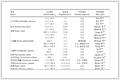
Table 1 Typical characteristics of main electrolysis technologies. Reprinted with permission from Ref. [3], copyright 2017 Elsevier.
|
Table 1
Typical characteristics of main electrolysis technologies. Reprinted with permission from Ref. [3], copyright 2017 Elsevier.
|
2 Water electrolysis for hydrogen production
In the water electrolysis process, water is the reactant, which is dissociated to hydrogen and oxygen under the influence of direct current.
Anode: H2O → 1/2O2 + 2H+ + 2e-
Cathode: 2H+ + 2e‒ → H2
Overall: H2O → H2 + 1/2O2
Different electrolytes systems developed for water electrolysis include alkaline water electrolysis (AWE), proton exchange membranes (PEMs), alkaline anion exchange membranes (AEMs), and solid oxide water electrolysis (SOE). Different materials and operating conditions are used in these systems; however, the operating principles are the same. On the basis of different operating temperatures, low and high temperature water electrolysis are also possible.
2.1 Alkaline water electrolyzer for hydrogen production
Alkaline water electrolysis operates at low temperature (60–80 ℃), with KOH and/or NaOH aqueous solution as the electrolyte, the concentration of the electrolyte is approximately 20%–30%. In an alkaline electrolyzer, the diaphragm is asbestos, and nickel materials are used as the electrode. The purity of the generated hydrogen is approximately 99%; however, an alkali fog in the generated gas must be removed, for which desorption is typically used. The maximum operating current density of an alkaline electrolyzer is less than 400 mA/cm2, and the power consumption for H2 production is approximately 4.5–5.5 kWh/Nm3 with an efficiency of approximately 60%. To avoid hydrogen/oxygen penetrating the porous asbestos diaphragm resulting in an explosion risk, the pressure between the anode and cathode sides must be balanced. Moreover, alkaline electrolyzers cannot start up quickly, and have a slow loading response. Long start-up preparation makes it difficult to adapt alkaline electrolyzers to the variable nature of renewable energy sources [4]. Therefore, alkaline electrolyzers are normally used with a steady power input.
2.2 Proton exchange membrane water electrolysis for hydrogen production
PEM electrolysis is based on proton exchange membrane fuel cell technology. Proton exchange membranes replace asbestos, with protons conducted in the membrane. Notably the gas permeability of a PEM is much lower than that of asbestos. Without an alkaline fog in the generated gas, PEM electrolyzers are more environmental friendly. Furthermore, the fast response, high efficiency, compact design, and high output pressure make PEM electrolysis a promising hydrogen production technology. An early PEM commercial product was developed in 1978 [5]. The operating current density of this system (10 A/cm2) was much higher than that of other alkaline water electrolysis technologies (Fig. 1). Additionally, balancing PEM electrolysis plants is much simpler, which is more attractive for industrial applications.
However, costs of the precious metals used as electrocatalysts for PEM electrolysis makes PEM electrolysis more expensive than alkaline electrolysis. Researchers have examined reducing the cost of PEM electrolysis, and improvements in the electrode materials have been made. The Department of Energy has targeted low-cost PEM electrolysis by 2020, see Table 2.
表 2
(Table 2)
Table 2 Department of Energy targets for the cost of PEM water electrolysis [7].
|
|
|
DOE 2015 target |
DOE 2020 target |
| Electrolyzer cost ($/kg H2)
|
|
0.50 |
0.50 |
| H2 production cost ($/kg H2)
|
|
3.90 |
< 2.30 |
| Electrolyzer efficiency |
LHV (%) |
76 |
77 |
|
kWh/kg |
44 |
43 |
| System efficiency |
LHV (%) |
72 |
75 |
|
kWh/kg |
46 |
44 |
|
Table 2
Department of Energy targets for the cost of PEM water electrolysis [7].
|
PEM electrolysis has been evaluated as a suitable technology for converting wind power into hydrogen generation by the United States of America National Renewable Energy Laboratory [8], and the costs of scaling up a PEM electrolyzer have been predicted [9]. It is expected that the cost of a PEM electrolyzer will be reduced to 1/4 of the current price when hydrogen generation reaches 1000 kg/d; current hydrogen generation systems are limited to 10 kg/d. Thus, large-scale PEM electrolysis for hydrogen generation should reduce costs.
Recently, a MW scale PEM electrolyzer was delivered by Proton Onsite and Siemens, reflecting that PEM electrolysis is on the way to industrial applications [10]. Shell, together with ITM Power, plans to install a 10 MW electrolyzer to produce hydrogen at the Wesseling refinery site within the Rheinland Refinery Complex [11]. The advantages of rapid start-up and response make PEM electrolysis a promising technology for handling the intermittent supply of renewable energy.
Large-scale hydrogen production as an energy storage medium with the use of electricity from wind power could be feasible, if the difficulty of wind power in the grid could be resolved. In September 2016, a wind and solar powered hydrogen filling station, the Tongji-Sunrise filling station, was built at Dalian. At that time a 10 MW electrolysis system with H2 capacity of 17 520 000 Nm3 H2/y was also announced in Hebei province [12].
Improving the effectiveness of electrocatalysts is a common strategy for improving the performance of water splitting. Catalytic activity is an important parameter in the evaluation of their performance. Long-term stability is another key parameter in assessing the quality of electrocatalysts for water splitting. Numerous studies on nanostructured electrocatalysts for water splitting in PEM water electrolysis have been published. RuO2 and IrO2 are ranked as the top catalysts for PEM water oxidation; while Pt is considered to be the benchmark electrocatalyst for the hydrogen evolution reaction (HER). However, the high cost of these precious metals prevents their large-scale practical application. Research on electrocatalysts for oxygen evolution reaction (OER) with high activation, good durability, and low cost is necessary to increase the energy efficiency and electrolyzer stability. Advances in this area could decrease the cost of H2 generation, and further accelerate the commercial development of the PEM water electrolysis technology. Considerable efforts have been made to synthesize iridium oxide-based electrocatalysts and study their performance. One method of reducing the electrode cost and improving the effectiveness is to introduce a second less-expensive metal, such as Ru, Sn, and Co. Another approach is to use a preparation method that gives good control over the electrode morphology at the nanoscale to enhance the electrocatalyst performance toward OER.
Thus, the use of less-expensive metals and electrode preparation methods that improve morphology at the nanoscale, could lead to considerable improvements in electrocatalyst performance toward OER [13]. Noble-metal Ir loading can be decreased to 0.78 mg/cm2 (a loading of 1.2 mg/cm2 is typical in previous reports). For example, with the use of an IrxSn1−xO2 anode catalyst (Ir loading ca. 0.78 mg/cm2) with a long block- length, the cell voltage achieved was only 1.621 V at 1000 mA/cm2 and 80 ℃, equating to a thermal energy efficiency of 91.3%.
2.3 New technologies for water electrolysis
High temperature solid oxide electrolysis (SOEC) has high energy efficiency; when the heat utilization is included, the efficiency is more than 90%. With the use of ZrO3 doped with 8-mol% Y2O3 as the electrolyte, anions transfer at high temperature in the SOEC. The solid oxide is thermally and chemically stable. Water electrolysis at high temperature requires a lower voltage, which means lower energy consumption [14]. The thermal efficiency of high temperature water electrolysis can reach 100% [15]. However, high temperatures present challenges in terms of material degradation and the duration of SOEC operation can be an issue. The generated hydrogen mixture with water vapor from SOEC requires additional treatment to obtain high purity hydrogen. Thus, SOEC technology is currently still under development. Sunfire is now testing an SOEC prototype for a hydrogen filling station in Karlsruhe, Germany [16].
There is great interest in developing naturally abundant nanomaterials that show high activities for HER / OER reactions and high stability for practical applications [17]. Hence, research interest has shifted to investigations of naturally abundant metal resources, such as Ni, Fe, and Co-based materials for alkaline water electrolysis. For the oxygen evolution reaction, Gao et al. [18] reported that nanostructured α-Ni(OH)2 spheres exhibited a small overpotential of 0.331 V at 10 mA/cm2, and a small Tafel slope of ~42 mV/dec, characteristics that were comparable to those of RuO2 catalysts. In addition,
α-Ni(OH)2 spheres have exhibited improved durability over RuO2. A study conducted by Ma et al. [19] showed that a Co3O4/C porous nanowire array had the capacity to achieve a current density of 10 mA/cm2 at an overpotential of 0.29 V, which was lower than that of IrO2/C (0.31 V) and other reported noble-metal catalysts.
Pt is considered the benchmark electrocatalyst for HER owing to its low overpotential and high kinetics. However, this metal resource is a limited and its high cost has hindered its large-scale application to electrochemical water splitting processes. A number of non-noble-metal materials, such as transition-metal chalcogenides, carbides, and complexes, as well as metal alloys, have recently been widely studied for use as catalysts, or catalyst supports for HER. For example, Karunadasa et al.
[20] synthesized a well-defined Mo(Ⅳ)-disulfide complex, which showed potential as a low-cost alternative to platinum for electrocatalytic generation of hydrogen. An additional study performed by Liu et al. [21] demonstrated that carbon nanotubes decorated with cobalt phosphide (CoP) nanocrystals exhibited superior HER catalytic activity in acidic media.
In summary, if replacement of proton exchange membranes with anion exchange membrane is successful, both the advantages of alkaline water electrolysis and PEM water electrolysis can be realized. Thus, AWE water electrolysis can be applied more widely. Ni, Co, and Fe could act as electrocatalysts in AEM water electrolyzers, and the costs of AEM systems will be much lower than that of PEM water electrolyzers. The requirements for materials in AWE bipolar plates are also much easier to meet. Thus, AEMs show great promise as a water electrolysis technology, once the key material, i.e., alkaline membranes and electrocatalysts are developed.
2.4 Prospects for water electrolysis based on renewable energy
Today, China is the largest producer of hydrogen and over the past 7 years, hydrogen production in China has been ranked first worldwide. Owing to production economics, 95% of that hydrogen production was derived from fossil energy. If the electricity usage of water electrolysis could be reduced, the hydrogen production industry would be considerably changed. The interconversion of electricity and hydrogen is becoming accepted by the public as a means of efficiently using abundant renewable energy.
Hydrogen from water electrolysis with high purity is applicable in the electronic, metallurgical, food, float glass, fine chemical, and aerospace industries. As an energy storage medium, in the future hydrogen could be used in hydrogen filling stations and HCNG, with a hydrogen production rate at 100–3000 Nm3/h. For these applications, bottled hydrogen and reformed hydrogen are not applicable. Water electrolysis technology generating hydrogen onsite from renewable energy without transportation could ensure efficient use. In the near future, hydrogen as an energy storage medium will become more widely used.
 2018,
Vol. 39
2018,
Vol. 39  PDF
PDF